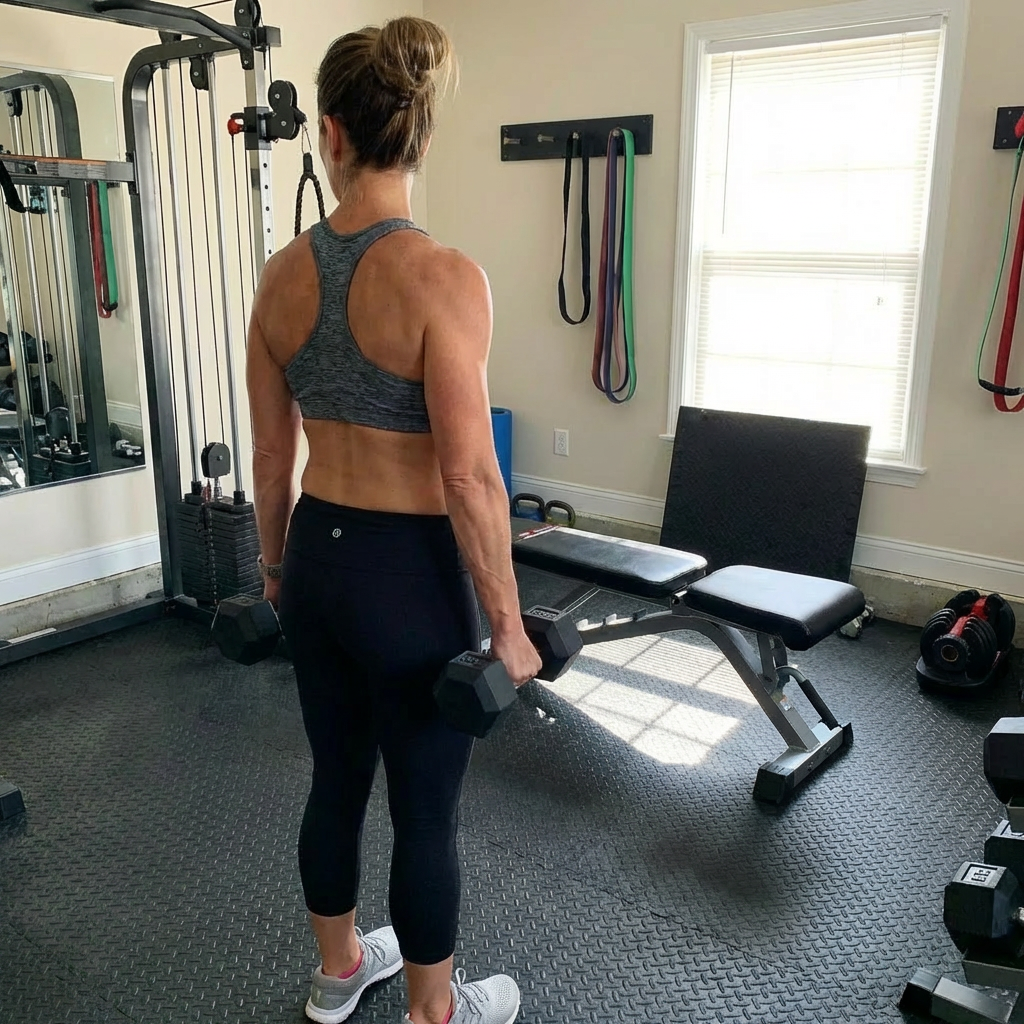
How Women Build Muscle After 40 (Without Living in the Gym)
If you want to build muscle after 40, you do not need to live in the gym. You don’t need five workouts a week. You don’t need to double your cardio. And you definitely don’t need to accept that getting softer and weaker is just part of aging.
For over half a decade, I’ve coached women in their 40s, 50s, and 60s who believed that lie for years. They weren’t lazy. They weren’t inconsistent. They were just following advice that sounds productive but doesn’t actually build muscle.
And after 40, muscle is the name of the game.
The Real Problem Isn’t Age. It’s Strategy.
Most women I talk to are doing more than enough. They’re in classes. They’re walking. They’re doing cardio circuits. Some are working out five days a week.
But when I ask a simple question — “Are you getting stronger?” — there’s usually silence.
Somewhere along the way, women were told fat loss meant:
- Move more
- Eat less
- Sweat harder
- Be smaller
So they try harder. They cut calories lower. They add another workout. They push through exhaustion.
And what happens?
The scale might move a little. But the mirror doesn’t reflect the change they hoped for. They feel softer. More tired. More frustrated.
That’s not a discipline issue. That’s a direction issue.
What Actually Changes Your Body After 40
If your goal is to build muscle after 40 while also supporting fat loss and hormone health, here’s the truth:
You need structured strength training.
Not random workouts.
Not chaos circuits.
Not “burn as many calories as possible.”
Structure.
Muscle grows when it’s challenged and then allowed to recover. That means lifting weights with intention, gradually increasing resistance over time, and giving your body the fuel and rest it needs.
Just THREE well-designed strength sessions per week is enough.
Yes. Three.
Not seven.
When those sessions focus on foundational movements like squats, presses, rows, and hinges, your body receives a clear message: “We need this muscle.”
And it responds.
A Client Story (Because This Is Real Life)
I worked with a woman in her late 40s who was convinced she needed more cardio. She was already working out five days a week, mostly high-intensity classes. She was exhausted and frustrated that her body looked “soft.”
We shifted her to three strength sessions per week. We increased her protein to 1.2g per kg of bodyweight. We reduced the chaos.
Within months, she was:
- Stronger than ever
- Leaner around her waist
- Sleeping better
- More confident in her clothes
She didn’t train more. She trained smarter.
And no — she did not get bulky at all!
Let’s Address the “Bulky” Fear
This one always comes up.
Women over 40 are often afraid that lifting heavier will make them look big. But muscle doesn’t grow overnight, and it doesn’t grow accidentally.
What usually creates the “soft” look women dislike is:
- Low muscle mass
- Higher body fat
- Chronic stress
- Undereating
Building muscle creates shape. It gives your body structure. It tightens and defines.
Low muscle with lots of cardio just shrinks everything without improving body composition.
That’s why strength training is the foundation.
What’s Actually Happening in Your Body
As women age, several natural changes occur:
- Muscle mass gradually declines
- Bone density decreases
- Metabolic rate slows slightly
- Hormonal shifts affect recovery and body composition
That sounds scary until you realize something important.
Strength training directly fights those changes.
Research published in Frontiers in Physiology shows that resistance training improves muscle mass, metabolic health, and overall function in aging adults. Other research in the Journal of Strength and Conditioning Research supports resistance training for preserving lean mass and improving body composition in women over 40.
In simple terms: your body still responds.
It just needs the right stimulus.
But What About Hormones?
Hormones matter. Absolutely.
But muscle improves insulin sensitivity, helps regulate blood sugar, and creates a healthier metabolic environment. When you build muscle, you improve the foundation your hormones operate in.
Ignoring muscle makes hormonal struggles worse, not better.
Strength training doesn’t “fight” your hormones. It supports them.
This Isn’t Anti-Cardio
Let’s be clear. Walking is incredible. I recommend it daily. It helps with stress, heart health, and overall wellness.
But cardio is a tool.
It is not the strategy.
Muscle is the strategy.
After 40, especially, strength is what protects your metabolism, your bones, your posture, and your independence.
The Simple 3-Day Framework
If you want to start building muscle without living in the gym, here’s your foundation:
Train 3 days per week
- Focus on full-body strength sessions
- Prioritize compound movements
- Gradually increase weight over time
Support your training
- Eat enough protein (around 1-1.3g per kilogram of body weight is a solid starting range)
- Walk daily
- Sleep as consistently as possible
- Stop chasing exhaustion
Consistency beats intensity.
Every time.
Strength Is Stewardship
From a faith perspective, this matters deeply. You are not called to shrink yourself into invisibility. You are called to steward your body well.
Strength is not vanity.
It is preparation.
It is resilience.
It is the ability to carry what life asks you to carry.
God did not design your body to fade quietly into weakness. But He did give you responsibility over how you train it.
Let’s Talk
If you’re over 40 and feel like your body changed overnight, I want to hear from you. Have you been stuck in the cardio cycle? Have you felt like you’re doing everything “right” but nothing is working?
Comment below or send me a message on Instagram. I read them.
And if this helped you, share it with another woman who needs to hear it.
If you’re ready for structure instead of guessing, explore your next step through my Training Plans or Services page. My coaching is built around three structured strength sessions per week, progressive overload, and real accountability — not trends, not chaos.
You don’t need more workouts.
You need a better system.
And your body is more capable than you think.
Leave a Reply