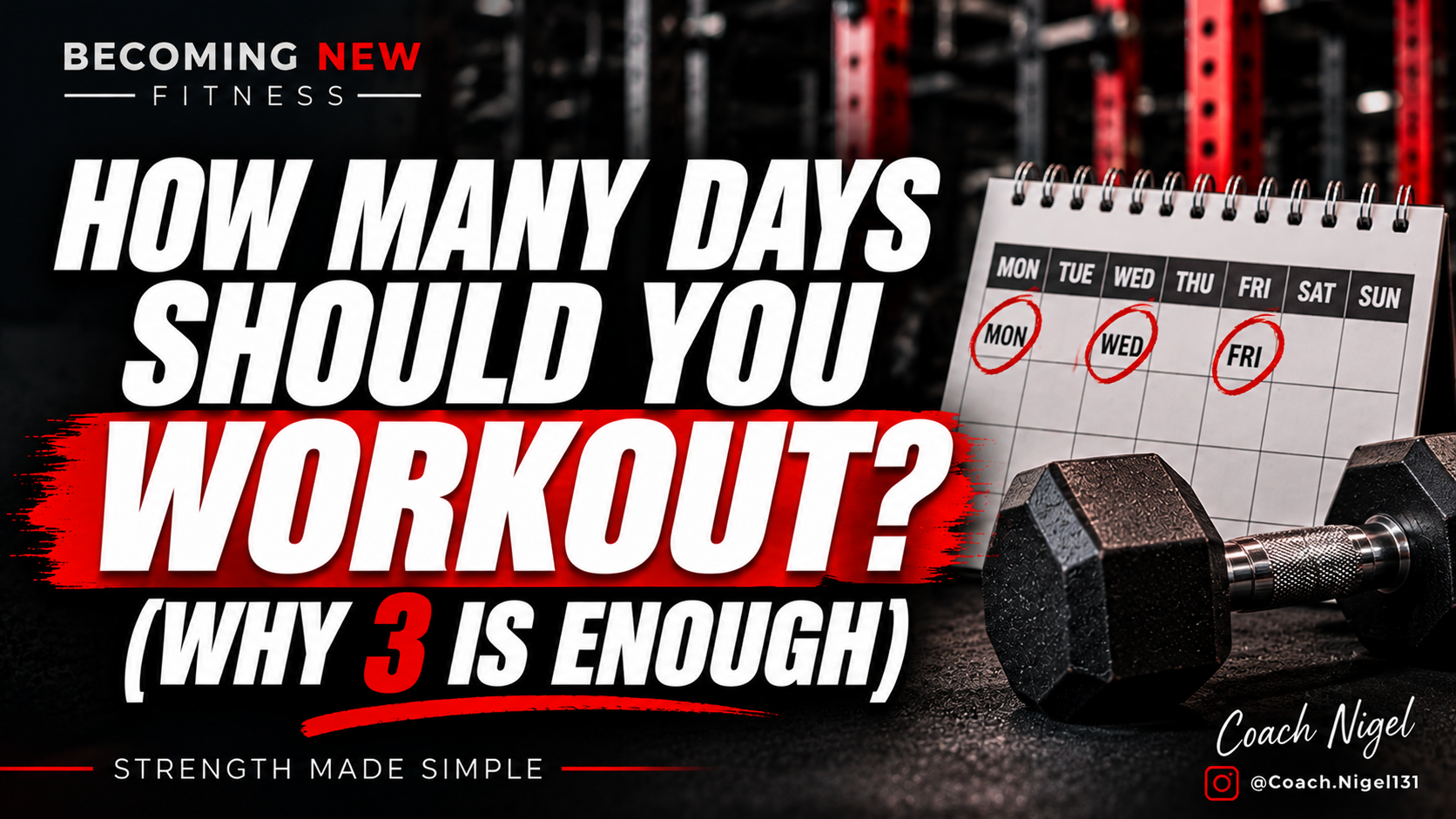
How Many Days Should You Work Out? (Why 3 Is Enough)
You don’t need to spend five or six days in the gym to build strength, muscle, and a healthier body. Here’s why three focused full-body workouts a week can be an incredibly effective approach.
If you’ve ever felt like you need to work out five or six days a week to get results, I have some good news for you.
You probably don’t.
Somewhere along the way, fitness became associated with spending every available day in the gym. Six-day workout splits, daily training schedules, and endless exercise routines have made it seem like more workouts automatically mean more progress.
But here’s the thing: your body doesn’t care how many times you check into the gym. It responds to the quality of the work you do, how consistently you do it, and how well you recover.
And for most people, three well-structured strength training sessions per week can go a long way.
Let’s talk about why.
More Workouts Don’t Automatically Mean More Results
One of the biggest mistakes I see people make is confusing activity with progress.
Just because you’re working out six days a week doesn’t necessarily mean you’re getting twice the results of someone training three days a week.
Think about it. If you’re training hard, challenging your muscles, and giving your body a reason to adapt, you’re also creating a need for recovery.
Your body needs time to repair and adapt to the work you’ve already done. Adding more workouts without considering recovery can create unnecessary fatigue, make it harder to perform well, and eventually make your training less sustainable.
This doesn’t mean training more than three days is bad. There are plenty of people who enjoy training four, five, or even six days a week.
But enjoying more frequent training and actually needing it to make progress are two different things.
The goal isn’t to do the most work possible. It’s to do enough quality work to get the results you’re after while still being able to recover and show up consistently.
And that’s where three days a week becomes a pretty attractive option.
Why Full-Body Training Three Days a Week Works
Instead of dividing your workouts into separate body parts throughout the week, I prefer a full-body approach.
That means training your major muscle groups during each workout rather than having one day dedicated exclusively to chest, another to back, and another to legs.
Why?
Because it allows you to train your entire body multiple times throughout the week without needing to spend every day in the gym.
A simple Monday, Wednesday, Friday schedule gives you three focused training sessions with recovery days in between.
Each workout can cover the six basic movement patterns:
- Squat: Leg press, goblet squat, or barbell squat.
- Hinge: Romanian deadlift or another hip-hinge variation.
- Vertical Press: Dumbbell or machine shoulder press.
- Vertical Pull: Lat pulldown or pull-up.
- Horizontal Press: Dumbbell bench press or push-up.
- Horizontal Pull: Seated cable row or dumbbell row.
You don’t need to perform every possible variation of these movements. You need a handful of exercises that cover the patterns, challenge your muscles, and allow you to make measurable progress.
Three focused workouts give you regular opportunities to practice these movements, stimulate your muscles, and gradually get stronger.
And because you’re training your whole body each session, you aren’t relying on one specific day to train an entire muscle group.
What About Rest Days?
This is where I want to challenge another common misconception.
Rest days aren’t wasted days. They’re part of your training program.
When you strength train, you’re creating a stimulus that tells your body it needs to adapt. But the actual process of recovery and adaptation happens outside the workout, too.
That’s why I like having rest days between full-body training sessions.
Your muscles, joints, tendons, and other tissues need time to recover from the demands of training. Sleep, nutrition, hydration, and managing your overall activity all play a role in that process.
But here’s something important: recovery doesn’t mean you have to sit on the couch all day.
Walking, light movement, and other low-intensity activities can fit perfectly into your recovery days.
You can take a walk, get outside, enjoy some fresh air, and keep your body moving without turning every day into another demanding workout.
You don’t have to earn your rest days, and you don’t have to feel guilty for taking them.
Sometimes the smartest thing you can do for your progress is give your body a chance to recover.
Three Days of Strength Training Doesn’t Mean Three Days of Fitness
Here’s where I want to make an important distinction.
Strength training is only one part of developing a healthy, capable body.
You also want to improve your cardiovascular fitness, conditioning, mobility, and general ability to move.
But that doesn’t mean you need to add another hour of exercise every day.
I like keeping conditioning simple, too.
Think of your activity in two categories:
Low-intensity cardio (LISS) includes activities like walking, treadmill walking, and cycling at a comfortable pace. It’s an excellent way to increase daily activity, support cardiovascular health, and burn additional calories without creating the same recovery demands as another hard strength workout.
Higher-intensity cardio and conditioning challenges your heart and lungs more directly. This can include short intervals, cycling, rowing, or other conditioning exercises that get your heart rate up.
Both have their place.
You can incorporate shorter conditioning sessions into your weekly routine while using walking and other low-intensity activity to keep yourself moving throughout the week.
The point is that you don’t need to turn every day into an intense gym session.
You can build strength, improve your conditioning, and increase your daily activity without making fitness a full-time job.
The 3-Day FIT System: Train. Recover. Perform. Repeat.
This is actually the thinking behind my 3-Day FIT System at Becoming New Fitness.
I built my approach around the idea that training should be effective, simple, and realistic enough to maintain.
The system follows what I call the TRP Method: Train, Recover, Perform, Repeat.
TRAIN: Two focused full-body strength workouts to build strength and muscle using the 6 basic movement patterns.
RECOVER: Give your body time to adapt through rest days, proper nutrition, hydration, and quality sleep.
PERFORM: Develop your conditioning and overall fitness through intentional cardio, walking, and additional movement that supports your ability to perform outside the gym.
REPEAT: Keep showing up, gradually improve your training, and allow those consistent habits to produce results over time.
Notice what’s missing?
Six-day workout splits. Endless exercise variations. Spending two hours in the gym. Trying to destroy yourself every time you train.
You don’t need any of that to make meaningful progress.
You need a plan that works, a schedule you can maintain, and enough consistency to give it time.
The Best Workout Schedule Is the One You Can Stick To
Let’s be honest.
Most people aren’t professional athletes. They have jobs, families, responsibilities, busy schedules, and plenty of other things competing for their attention.
Your fitness routine needs to account for that.
If you can realistically commit to three workouts per week, build your program around three workouts per week.
Don’t create a six-day schedule that looks great on paper but constantly leaves you feeling behind because you can’t keep up with it.
Start with something manageable. Build confidence. Establish the habit. Then gradually improve.
And remember, you don’t need to be perfect.
Missed a workout? Get back on schedule.
Had a busy week? Pick up where you left off.
Didn’t get your walk in yesterday? Take one today.
Fitness isn’t about never missing a day. It’s about developing habits that allow you to keep moving forward even when life doesn’t go according to plan.
That’s what makes a program sustainable.
Simple is boring. Boring is consistent. Consistency produces results.
You don’t need more gym days. You need a better plan for the days you have.
And that’s exactly what Strength Training Made Simple is all about.
Want Help Putting This Into Practice?
Knowing that three days of strength training can be enough is one thing. Knowing exactly what exercises to perform, how to structure your workouts, how to incorporate conditioning, and how to progress toward your goals is another.
That’s where coaching comes in.
At Becoming New Fitness, I provide fully remote personal training and online fitness coaching built around the 3-Day FIT System and the TRP Method.
No gimmicks. No unnecessary complexity. No pressure to live in the gym.
Just a practical plan built around your goals, your current fitness level, and what you can realistically do consistently.
If you’re ready to stop guessing and start training with a plan, explore the coaching and training options available through Becoming New Fitness.
Explore Coaching & Training
Ready to talk about what coaching could look like for you?
Book a Coaching Call
Leave a Reply